Author: Dr Laila Surani
When we think about ageing, most of us imagine later life—retirement, declining health, or the need for care. As a result, many services and policies focus only on older adults, often responding to problems once they appear.
But what if ageing doesn’t begin at 60 or 65?
What if it begins much earlier—at birth?
The Life Course Perspective: A Different Way to Understand Ageing
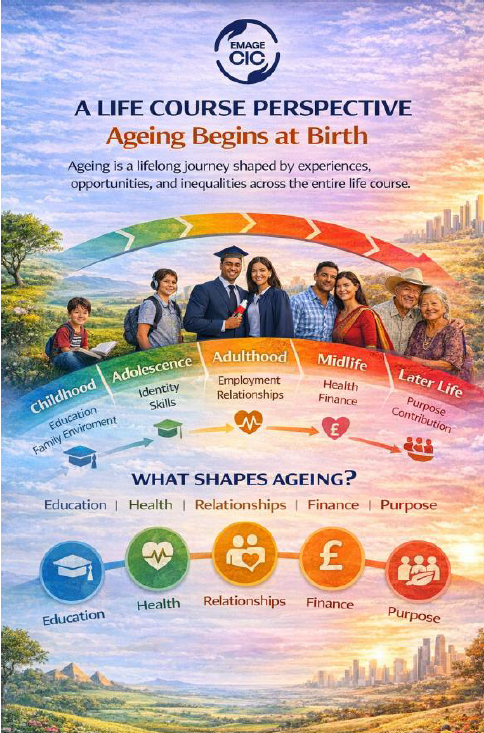
The life course approach helps us understand that ageing is not a single stage—it is a lifelong process.
Researchers such as Elder (1998) and Ben-Shlomo & Kuh (2002) explain that our health, wellbeing, and quality of life in later years are shaped by our experiences across life.
For example:
• Education in childhood influences opportunities in adulthood
• Employment and income affect long-term health
• Social relationships shape emotional wellbeing over time
This means that the way we age is not accidental—it is built over time.
So, Where Are We Going Wrong?
Despite strong evidence, many systems still:
• Focus only on older adults
• Work in silos (separate services for children, adults, and older people)
• Overlook cultural and community needs
• Miss opportunities for prevention
This creates fragmented support, where people only receive help when problems become serious.
What Is Missing?
There are several important gaps:
- Lack of Community-Level Implementation
Life course theory is widely discussed—but rarely applied in real community settings. - Limited Cultural Inclusion
Many approaches do not reflect the realities of ethnic minority communities, where culture, faith, and family play a central role in ageing. - Disconnected Life Stages
Services are often divided by age, rather than connected across life. - Weak Intergenerational Links
We talk about “linked lives,” but rarely create spaces where generations truly connect.
How EMAGE Is Responding
At EMAGE, we are working to bridge these gaps through our Life Course Model for Healthy, Inclusive & Active Ageing.
Our approach:
✔ Supports individuals from childhood to later life
✔ Connects different life stages instead of separating them
✔ Embeds cultural and community values
✔ Promotes intergenerational relationships
✔ Works collaboratively with existing organisations
From Theory to Real Communities
Rather than creating new services in isolation, EMAGE focuses on:
• Strengthening existing community spaces
• Partnering with organisations
• Empowering volunteers
• Co-designing programmes with communities
This means we are not just applying theory—we are bringing it to life.
Why This Matters Now
As populations age, the challenge is not just to help people live longer—but to help them live well.
A life course approach allows us to:
• Prevent health inequalities
• Build stronger, more connected communities
• Support people at every stage of life
A New Way to Think About Ageing
Ageing should not be seen as decline.
It should be seen as:
• A lifelong journey
• A shared community experience
• An opportunity for continued growth and contribution
Final Thought
If we want better outcomes in later life, we need to start much earlier.
Because ageing doesn’t begin at retirement—
It begins at birth.